A learning cycle for redesigning work in real conditions.
Leadership does not happen in a classroom. It happens in the friction of daily operations. This process uses the real-world conditions of your organization as the lab for systemic change.
We do not teach leaders how to carry a heavier load. We facilitate the work of redesigning the load itself.
Each stage builds on the last.
The cycle moves from awareness through to integration — always grounded in what leaders are actually experiencing, not in abstract frameworks or pre-packaged solutions.
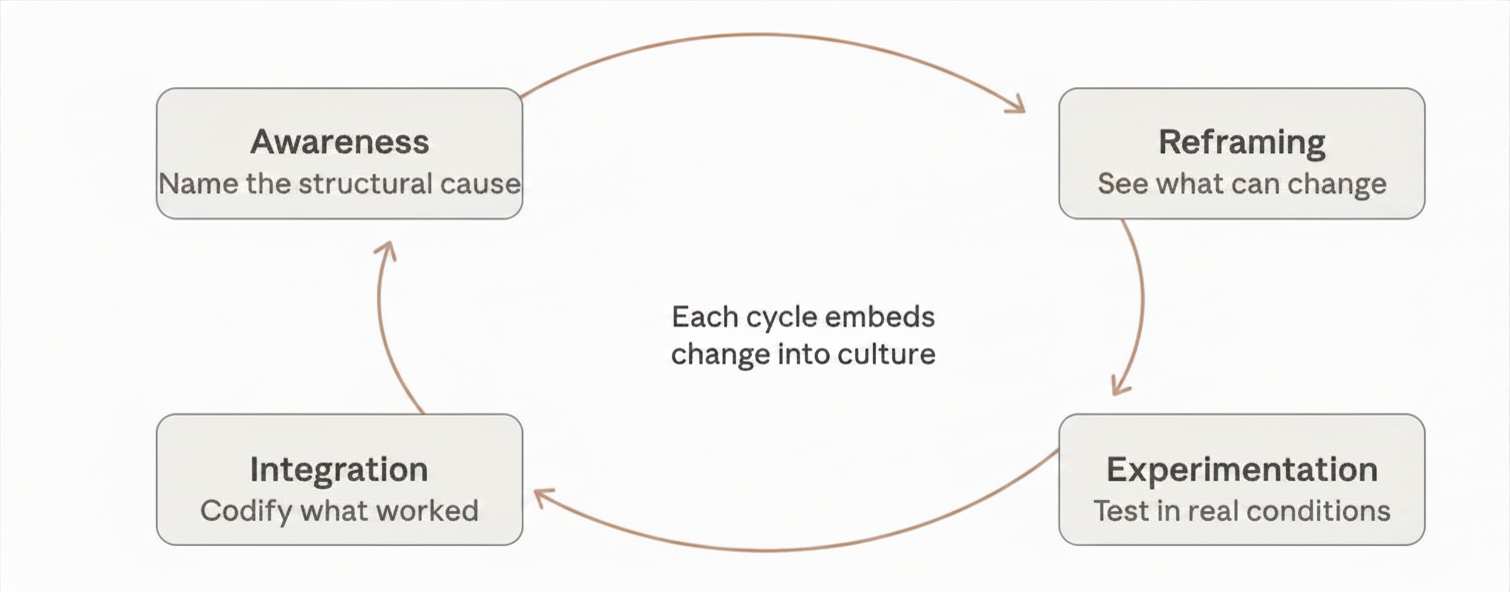
Awareness
Move beyond surface-level symptoms to map the structural drivers of fatigue. This is not about identifying who is struggling — it is about identifying what the system is producing and why.
Leaders examine decision bottlenecks, role overlaps, invisible workarounds, and the patterns of work that concentrate pressure in the wrong places.
Reframing
Clarify what is within a leader's control to change. This stage separates fixed constraints from the variables that can be redesigned — and builds the case for change with the people who need to act on it.
Leaders stop absorbing the system's dysfunction and start seeing themselves as architects of the conditions they work in.
Experimentation
Run practical tests in daily work. New protocols for decision-making, delegation, communication, meeting rhythms, and boundary-setting — designed specifically for the conditions leaders are working in, not for an idealized version of their organization.
Each experiment is small enough to test quickly and specific enough to produce useful data. Leaders learn what works in their actual context — not in a case study.
Integration
Codify what worked into team practices and role expectations. The reset becomes part of how the leadership layer operates — not a temporary fix that fades when the facilitator leaves, but a new baseline that the team maintains.
Leaders leave with documented changes to how work flows through their organization — changes they designed, tested, and own.
What makes this method different.
Context-first
Every session starts from what's actually happening in your organization — not from a curriculum or a framework imposed from the outside.
Leaders as architects
The facilitator doesn't tell leaders what to do. The process creates the conditions for leaders to design their own solutions — and own them.
Small tests, real learning
Change happens through small, fast experiments — not through large planned transformations that take months to show results.
See the method in action.
Every engagement starts with a conversation about what's actually happening in your organization — no commitment required.